
AI Utopia (?)
The Road to (through) the AI Dystopia

Peter Diamandis is a “founder, investor, and philanthropist focused on creating a world of abundance through exponential technologies.” In addition to the many businesses and foundations he has founded or co-founded, he is the host of the popular “Moonshots” podcast, of which I am an occasional listener.
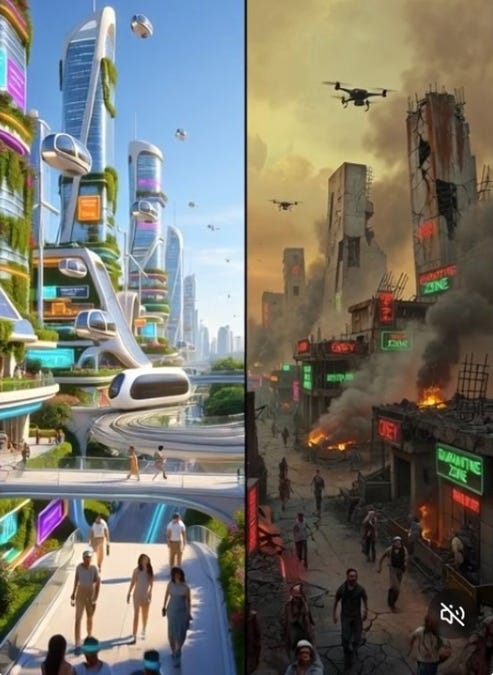
The unabashed AI optimist posted on X earlier this month, “Hollywood convinced generations of a dystopian future because happiness was too boring for movies. We need better storytellers to show how our future will be abundant.”
I’ve written previously on Hollywood’s dystopian view of the future, but Dr. Diamandis’ post does bring forth two good questions; first, are there any fictional takes on a world of abundance that could give us hope, and second, would we have any reason to believe a hopeful story of future abundance, or would it be just another fairy tale?
A Fictional World of Abundance
There is certainly no lack of dystopian futures in Hollywood. Over the last year, my wife and I have been revisiting many of these movies to see how they hold up against our current reality. The original “Terminator” and “T2” (the only Terminator movies worth re-watching, in my opinion), “I, Robot,” “Ex Machina,” Spielberg’s “AI: Artificial Intelligence,” to name just a few. Each of them offers a number of, “Wow, they got that right” moments.
The best of the best, is the early 2000’s “Battlestar Galactica.” We rewatched the series in 2025, and it holds up remarkably well, both in terms of the visual effects, the dark post-9/11 vibe, and the human-centered storytelling. That said, as entertaining as it is, I don’t think a series about humans going to war with their robotic creations (and almost going extinct) is the story of abundance that Peter Diamandis is looking for.
The closest that Hollywood comes is perhaps 2013s “Her,” a ‘romance’ set in a prosperous looking and peaceful world with ubiquitous AI. The AI is built into the fabric of people’s lives, to the extent that it’s taken for granted. But the world that “Her” portrays is also a world bereft of human connection where people turn to AI for companionship, friendship, and love. There are scenes of people, mostly men, walking through the streets, holding up screens in front of them and conversing with their AI girlfriends. If this is the promised future of abundance, I want nothing to do with it.
To find a positive story of future abundance, one must leave Hollywood for the pages of 20th century science fiction. The best example of a fictional future abundance (that I’m aware of) is contained within the pages of Arthur C. Clarke’s classic 1953 novel “Childhood’s End.”
Clarke is the prescient author of numerous sci-fi novels, who accurately predicted scientific advances such as geostationary satellites, the internet, mobile phones, and telecommuting. And, of course, he is the author of “2001: A Space Odyssey,” which features a rogue AI system.
“Childhood’s End,” however, is much more optimistic. In the beginning, at least. The novel opens with mankind in a race to the stars. The United States and the Soviet Union are each on the cusp of launching a mission, battling to determine who will be first. On the eve of mankind’s first launch, a group of spaceships suddenly appear over several major cities across the world. There is no doubt left that mankind is not alone in the universe.
The benevolent aliens who pilot these ships, known as the Overlords, are real beings, not artificial intelligence. For the sake of argument, however, we can swap these kindly, technologically advanced beings for a benevolent AI. In either case, they are technologically superior to current humans, expert at manipulation, with surveillance technology that makes them seem omniscient.
At first, groups of humans rebel, with no interest in being ruled by Overlords, no matter how benevolent they may seem. Nations resist, objecting to the dissolution of national borders and corresponding identities. Ultimately, the Overlords win, in no small part by simply waiting out those who resist. The Overlords are patient, and eventually the resistance (literally) dies out. A Golden Age is ushered in.
“By the standards of all earlier ages, it was Utopia. Ignorance, disease, poverty, and fear had virtually ceased to exist. The memory of war was fading into the past as a nightmare vanishes with the dawn; soon it would be outside the experience of all living men.”
Abundance becomes a reality. War, crime, disease, and poverty that have plagued mankind for millennia are eliminated. Freed from these curses, mankind is then gifted with technologies to provide for all material needs and wants. Accordingly, work is no longer a four-letter word that dogs a man’s existence. It becomes a choice, something that is done purely for self-satisfaction.
“The average working week was now twenty hours – but those twenty hours were no sinecure. There was little work left of a routine, mechanical nature. Men’s minds were too valuable to waste on tasks that a few thousand transistors, some photo-electric cells, and a cubic meter of printed circuits could perform. There were factories that ran for weeks without being visited by a single human being. Men were needed for trouble-shooting, for making decisions, for planning new enterprises. The robots did the rest.”
This is the world of abundance that AI proponents dream of. Disease eliminated through technological discovery. Crime eliminated through surveillance, and the removal of societal injustices. War eliminated through the dissolution of borders and national identities, along with the end of the need for trade or resource dominance. Basic needs available to everyone, everywhere, at no cost. Mankind is freed from striving, and allowed to live a life of either discovery and growth, or outright leisure.
That may sound appealing. Who wouldn’t want an end to disease, poverty, hunger, and war? But, even the most perfect world we can imagine comes with a cost. Not the least of which is a loss of purpose. Clarke’s future world also includes the downside to a world of sudden abundance – boredom and a search for meaning.
“No Utopia can ever give satisfaction to everyone, all the time. As their material conditions improve, men raise their sights and become discontented with power and possessions that once would have seemed beyond their wildest dreams. And even when the external world has granted all it can, there still remains the searchings of the mind and the longings of the heart.”
Mankind is given everything it needs to survive. Except a reason to survive. In short, there is no purpose, and no future to strive for.
“Yet among all the distractions and diversions of a planet which now seemed well on the way to becoming one vast playground, there were some who still found time to repeat an ancient and never-answered question; “where do we go from here?””
Where indeed? The answer most AI optimists would provide is, “to the stars.” In Clarke’s novel, the Overlords prevent mankind from pursuing any efforts at space travel. Presumably, our AI overlords wouldn’t have that same edict.
AI optimist and space travel proponent Elon Musk responded to Diamandis tweet with “The older seasons of Star Trek were a positive view of the future.” Fair enough. But then reality sets in. William Shatner was quick to point out, “That’s because their ancestors lived through these dystopian times and found the only way to survive was to hope for a positive future for the planet.”
If you’re not familiar with Star Trek lore, what Shatner is referring to is that long before Starfleet and the Federation, there were wars that resulted in the deaths of tens of millions. And therein lies the rub. Even if we were to believe in a future of material abundance, how do we get there from here? How do we achieve abundance without massive suffering along the way? That, more than Skynet, is what frightens people now.
The Abundance Fairy Tale and the Road to (through) Dystopia
In Clarke’s novel, change is sudden, with the unexpected arrival of aliens. Even so, the Overlords have a carefully crafted plan to win over mankind, to usher them forward peacefully towards a better life.
What’s needed in 2026 aren’t stories about future abundance. We need a glimpse of a peaceful transition to that state, and not the immense loss of life and suffering contained in the Star Trek universe.
The change that is upon is now, with the arrival of millions of AI aliens, promises to be more chaotic that what Clarke envisioned in his novel. We blithely refer to that chaos as ‘disruption,’ which some view as a good and necessary thing, even as lives and livelihoods will be destroyed. In order to be prepared, it’s important to understand just how much disruption is already underway.
Clarke was a brilliant man who accurately predicted many technological advances. It wasn’t just a fertile imagination, it was calculated insight into a probable future. Even now, more than 70 years after its publication, certain aspects of his vision of the future world depicted in “Childhood’s End” are beginning to come true.
In late 2025, a number of western executives, including the CEO of Ford, visited China for discussions on manufacturing capabilities. One shocking thing they reported was the ongoing operation of ‘dark factories.’ Factories that were operating 24/7, in the dark, because the robots that were producing the end products don’t require illumination to operate. Clarke’s vision of robot factories producing endless streams of goods without human intervention is already here. At least it is in China.
The US government is putting significant effort into repatriating manufacturing to the states, but for how long will we be able to compete against the robots? If robots can work 24/7 without a break – without need for lights, or break rooms, or health insurance, or vacations, or unions, or OSHA, or fair labor laws, or all the other myriad things that go along with human workers – how long can human operated factories compete in a global economy? Let’s say there is a resurgence of manufacturing in the US. How long can we expect that to last before those workers are once again out of job, replaced by robots?
Despite the current reality of robot operated factories in the East, the predicted job losses in the West are primarily white collar jobs. The expectation is that AI will replace everything from entry-level positions, to programmers, engineers, architects, scientists, accountants, doctors, lawyers, and on, and on. The only people who are secure are the billionaire tech bros, until AI reaches the point where CEOs too are obsolete. At that point, the billionaires have only to retire to their bunkers, or their super-yacht fleets, far away from the huddled and hungry masses.
The advice from the tech world is to pursue a career in something that requires ‘touch.’ Be a plumber, or a massage therapist, because AI won’t be in a position to take those types of jobs for several years yet. But, if no one has a job, who can afford a plumber? Who can afford a massage, or dance or gymnastics lessons for their kids?
The thought process of business leaders seems to be that replacing expensive and messy humans with cheap AI will reduce the costs of their goods and services. But if no one has a job, who is purchasing those goods and services? If large swaths of the tax base are eliminated, who is paying to keep the government operating? If everyone needs unemployment, then who is left to fund that unemployment, not to mention Social Security, Medicare, law enforcement, and national defense?
The impact reaches far beyond white collar employees, and even the impending effects on blue collar factory workers. It reverberates through the entire economy. It’s the restaurants that cater to the lunch crowd, the farmers that grow the food, the cleaning crews that clean the restaurants and the offices, the store owner who sells dance or sports clothing, the teachers and coaches, the delivery drivers, the movie theaters, and so on. In an economy based largely on consumption, if you eliminate the means to consume, the ‘disruption’ will be massive, and it’s going to hurt. A lot.
The disruption to the labor market is already underway, and according to several analysts, very likely under-reported. We’re told that the solution will be some form of universal basic income (UBI) that will allow families to survive while their worlds are upended. Unfortunately, the math of UBI doesn’t add up. There simply isn’t enough money available to support even basic subsistence if the job losses meet predictions. The billionaires will be holed up in their bunkers and their yachts, while the rest of us are eating cricket pellets produced in government owned, robot operated, factories.
This is all assuming we live long enough for this to occur. Alongside the numerous predictions of AI just wiping us out (which I honestly don’t believe), there is the very real prospect of loss of life as jobs evaporate, and the social fabric unravels.
In the film “The Big Short,” about the 2008 financial crisis, trader Ben Rickert (Brad Pitt) turns to two young traders as they celebrate the return on their bet that the housing market will collapse; “Here’s a number – every 1% unemployment goes up, 40,000 people die. Did you know that?”
That line is based upon research by sociologist M. Harvey Brenner in the 1970s. His research showed that as unemployment grew, deaths from stress (e.g., heart attacks), lack of medical care, suicide, homicide, and substance abuse, all increased. The accuracy of his research is debated, but even if he’s only partially correct, if tens of millions of people lose their jobs, the associated deaths will quickly start to mount.
The ruin of millions, and the death of hundreds of thousands, is just so much collateral damage in pursuit of Utopia. That’s something that’s usually left out of the fairy tales.
People are skeptical of the promised abundance when the reality in front of them looks more like dystopia. Would positive stories of future abundance change our outlook? Do we just need good storytellers to spin a yarn about how great it’s going to be over the horizon? It’s hard to be optimistic when between you and the horizon is a swamp filled with punji sticks, landmines, and monsters. And the dawning realization that if you want to save your family, you’ll need to step over your fellow human beings in order to get to the promised land.
The problem that the tech community has isn’t that we don’t have good storytellers to paint a rosy picture of the future, it’s that we have history. History tells us that our government and corporations have zero interest in our well-being. One need to look no further than big pharma and big ag and the regulations (or lack thereof) that have poisoned us for decades. And, of course, the pandemic.
Big tech sold us on the internet and social media with promises that it would free up our time, and bring us closer together. Instead, it drove work into our homes and gave our corporate masters access to us 24/7. Social media has helped fracture the fabric of society, creating divisions, selling lies, causing brain damage to young people, addicting men to pornography, and engineering addictive technology to keep the ‘attention economy’ alive and profitable.
No positive storyline is going to erase the knowledge that the same industry that knowingly addicted millions to their smartphones is now unleashing AI upon us. We have no reason to believe that Silicon Valley has suddenly discovered ethics. In fact, we know the opposite to be true. We know that the industry stole millions of copyrighted materials, illegally stripping the copyright notices and ISBNs, and feeding them to their LLMs. We’ve all seen the headlines about the labs abandoning any pretext of safety.
The tech industry wants us to put our trust in the technology to deliver an abundant future, while doing absolutely nothing to earn that trust.
There’s an operating principal in Silicon Valley, originated at Meta by Mark Zuckerberg – ‘move fast and break things.’ In the AI world, things are moving fast, and what stands to be broken is you and your family. And your spirit.
Choose your metaphor – the genie is out of the bottle, Pandora’s box is open; pick your poison. There’s no stopping it now. The question is how do we not only live with it, but how do we thrive? Saying that there’s an abundant future out there, somewhere, in an indeterminate future, and we just need to be patient, isn’t enough. No amount of storytelling is going to fix that.
If this seems daunting to you, you’re not alone. I struggle with this daily. How to prepare, how to care for my family, how to live in a world that seemed unimaginable even a few short years ago.
I don’t pretend to have any answers – and I would certainly be open to suggestions – but I offer a few thoughts. Get your finances in order, quickly. Make paying off debt a priority. Build up your reserves. Diversify your income, if possible. If you have any land available, even a small backyard, or some pots on an apartment balcony, start growing your own food.
Above all, learn. The AI genie is out of the bottle and there’s no putting it back. Start working with the genie on a daily basis. Learn it, study it, use it. The more you know, the better off you’ll be. If you can incorporate it into your job, do it. If you can develop a side hustle, so much the better.
Finally, be resilient. Develop a survivor mindset. Gather your friends and family around you. Build a community. We’re going to need each other.
For those in the tech community – if anyone is actually listening – here’s what we see from the outside looking in; you’re making ungodly amounts of money developing a technology whose stated goal is to put the rest of us out of work. Telling the guy who’s working multiple jobs to feed his family, or the single mom that’s barely scraping by, that they just need to be entrepreneurs is infuriatingly arrogant. Seriously, just stop.
We don’t need stories. We need a plan. A serious, detailed, plan. Move fast, break things, and fix it later, isn’t enough when the things you’re breaking are people’s lives.
Towards the end of “Childhood’s End,” as mankind drifts aimlessly through its Golden Age of abundance, Arthur C. Clarke noted that maybe getting everything you want isn’t enough; “Gold was also the color of sunset, of autumn.”
Let’s work together to make sure that AI doesn’t usher in the sunset of humanity.
P.A. Tennant – February, 2026
Soli Deo Gloria
--------------------
Photo: P.A. Tennant with Grok Imagine
Copyright 2026 Paul A. Tennant
Substack:

Website:
https://patennant.com/